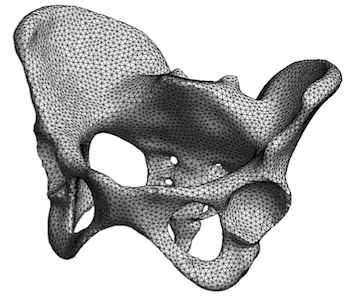
Gmsh is an open source 3D finite element mesh generator with a built-in CAD
engine and post-processor. Its design goal is to provide a fast, light and
user-friendly meshing tool with parametric input and flexible visualization
capabilities. Gmsh is built
around four modules
(geometry, mesh, solver and post-processing), which can be controlled with
the graphical user
interface, from
the command
line, using text files written in Gmsh's
own scripting
language (.geo files), or through the C++, C, Python, Julia and
Fortran application
programming interface.
See this general presentation for a high-level overview of Gmsh and the reference manual for the complete documentation, which includes the Gmsh tutorial. The source code repository contains the tutorial source files as well as many other examples.
Gmsh is distributed under the terms of the GNU General Public License (GPL):
pip install
            --upgrade gmsh
'
Make sure to read the tutorial and the FAQ before sending questions or bug reports.
git clone
          https://gitlab.onelab.info/gmsh/gmsh.git
'
pip install -i https://gmsh.info/python-packages-dev
        --force-reinstall --no-cache-dir gmsh
' (on Linux systems without
X windows, use python-packages-dev-nox instead of
python-packages-dev)
If you use Gmsh please cite the following reference in your work (books, articles, reports, etc.): C. Geuzaine and J.-F. Remacle. Gmsh: a three-dimensional finite element mesh generator with built-in pre- and post-processing facilities. International Journal for Numerical Methods in Engineering 79(11), pp. 1309-1331, 2009. You can also cite additional references for specific features and algorithms.
Please report all issues
on https://gitlab.onelab.info/gmsh/gmsh/issues.
Gmsh is copyright (C) 1997-2022 by C. Geuzaine and J.-F. Remacle (see the CREDITS file for more information) and is distributed under the terms of the GNU General Public License (GPL) (version 2 or later, with an exception to allow for easier linking with external libraries).
In short, this means that everyone is free to use Gmsh and to redistribute it on a free basis. Gmsh is not in the public domain; it is copyrighted and there are restrictions on its distribution (see the license and the related frequently asked questions). For example, you cannot integrate this version of Gmsh (in full or in parts) in any closed-source software you plan to distribute (commercially or not). If you want to integrate parts of Gmsh into a closed-source software, or want to sell a modified closed-source version of Gmsh, you will need to obtain a commercial license: please contact us for details.
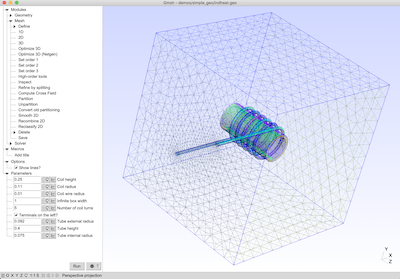
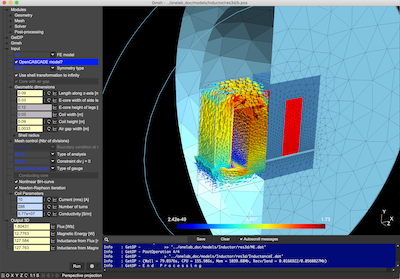
These are two screenshots of the Gmsh user interface, with either the light or dark user interface theme. See the ONELAB web site for more.
The search string evocam inurl:webcam.html belongs to a class of search engine queries known as "Google Dorks." Security researchers and attackers use these targeted queries to find specific hardware, software vulnerabilities, or exposed administrative panels indexable by public search engines.
The curtains were moving. Not a draft. They were being pulled back.
Many devices ship with no password or a common default (like "admin/admin"). evocam inurl webcamhtml upd
> CONNECTION ESTABLISHED. IDENTIFY YOURSELF.
Evocam is a software application that enables remote monitoring and management of IP cameras, webcams, and other surveillance devices. It allows users to access live video feeds, configure camera settings, and receive notifications and alerts. Evocam supports various types of cameras, including IP cameras, webcams, and CCTV cameras. The search string evocam inurl:webcam
This article explores the technical and security implications of the search query "evocam inurl webcamhtml upd," a specific "Google Dork" used to identify active webcam servers hosted by the legacy macOS software, EvoCam. What is EvoCam?
Instructs search engines to find websites that have "webcam.html" in their URL, which is a common default page for EvoCam feeds . They were being pulled back
: Place a robots.txt file in the root directory of the web server containing Disallow: / to instruct legitimate search engine crawlers not to index your streaming pages.
By combining these terms, a malicious actor can locate a list of live, unsecured camera feeds with minimal effort.
The exposure of webcam.html feeds results in severe privacy violations. These feeds often monitor: